
ŌU PĀTAI PARAIRE | Your Questions, Explained

Questions are part of understanding any process — and sometimes the simplest pātai can open the door to a much bigger kōrero.

Ōu Pātai Paraire takes some of the questions that arise around Whangaroa’s historical claims and explores the information behind them in a clear and straightforward way.

One pātai at a time.
Claims behind them

Who Sits Behind a Wai Claim?

When we see a Wai number, we will usually also see the name of a claimant — or sometimes several claimants.

Those names carry a story of their own.

They are the people who stepped forward to carry the claim. For many, that meant years of research, gathering kōrero and evidence, attending hui, working with lawyers and eventually standing before the Waitangi Tribunal.

That mahi asked a lot of those who carried it.

Read more…
For many, there was also a deeply personal and emotional responsibility in giving voice to the experiences of their people.

But the name beside a Wai number doesn’t always tell us the whole story.

Under the Waitangi Tribunal process, a claim can be brought by Māori about harm they themselves have experienced, or about harm experienced by a group of Māori of which they are a member. Claimants are asked to identify the people they represent — which might include whānau, hapū or iwi.

So when we want to understand one of our Whangaroa claims, there are a few things worth looking at.

Who brought the claim?

But also:

Who did they bring it for?

What grievance were they carrying?

What whenua and people did it concern?

And what did the claim itself actually say?

Sometimes the kōrero may be particular to an individual or whānau.

Sometimes it reaches across a hapū, whenua and generations.

And sometimes those things sit together.

That doesn’t diminish the person who stepped forward.

In many cases, it helps us better understand the significance of what they were carrying.

Because behind a Wai number there can be much more than a name.

There can be whānau.

There can be hapū.

There can be whenua, whakapapa and generations of history.

All of these are part of the story our claims carry.

Claims what are they web

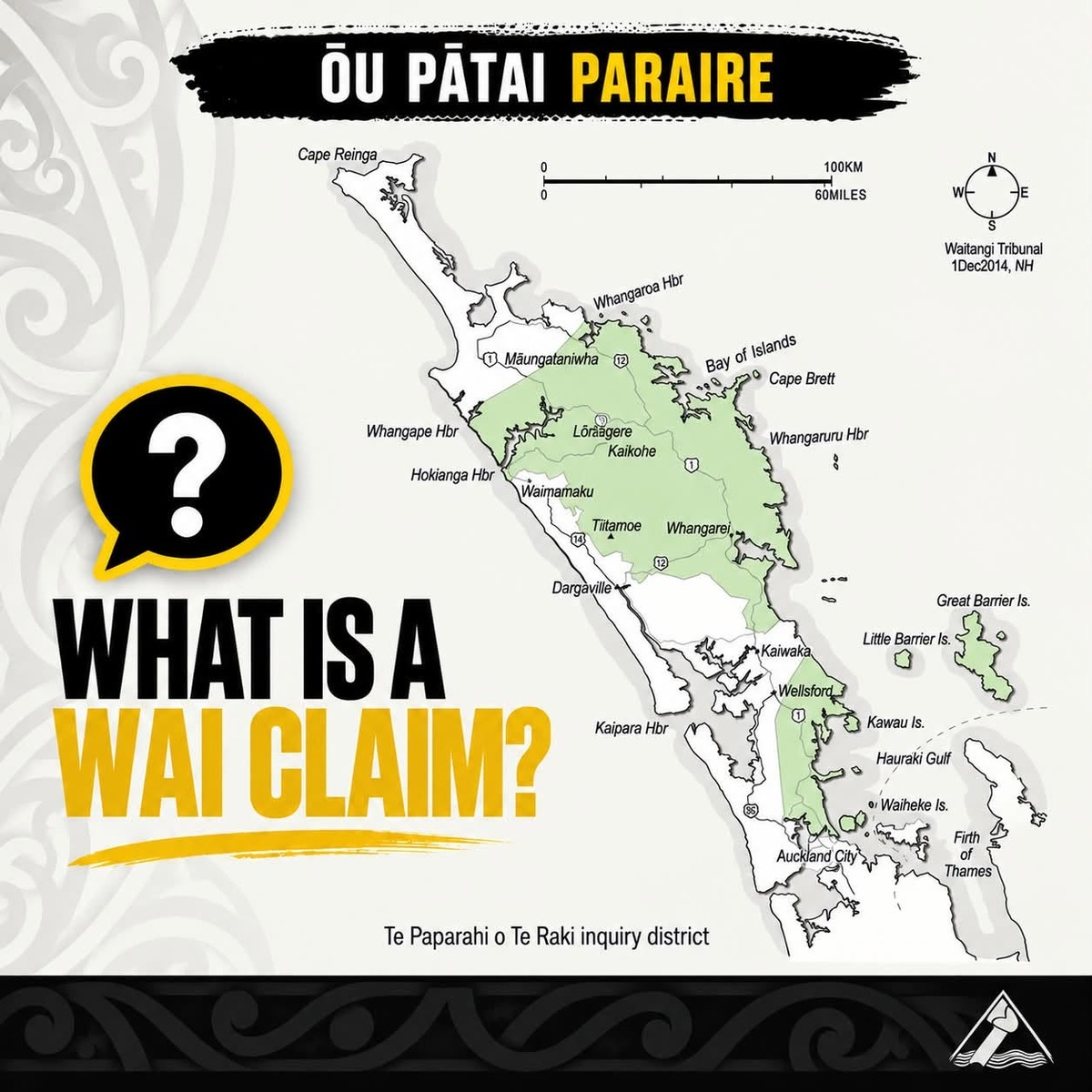
What is a Wai Claim?

We hear them often — Wai 58, Wai 230, Wai 919, Wai 1040…

But what actually is a Wai claim?

A Wai claim begins when Māori bring a claim to the Waitangi Tribunal alleging that an action, inaction, law or policy of the Crown has breached Te Tiriti o Waitangi and caused harm.

If the claim meets the requirements to be registered, the Waitangi Tribunal gives it a Wai number — “Wai” being short for Waitangi Tribunal claim.

So a Wai number is a reference number for a claim.

Read more…
Behind that number, though, can sit generations of history — whenua, whakapapa, Crown actions, promises, loss and the experiences of whānau and hapū.

So where does Wai 1040 come in?

This is where it can get confusing.

Wai 1040 is the Te Paparahi o Te Raki Inquiry.

Rather than hundreds of northern claims being heard entirely on their own, the Waitangi Tribunal brought claims together through this wider district inquiry.

Te Paparahi o Te Raki inquired into around 415 claims brought by hapū from across Te Raki.

That included the claims and evidence brought forward by our people from Whangaroa.

There is one other thing worth knowing.

Being given a Wai number did not mean the Tribunal had decided that a claim was proven. Nor did registration itself establish that the named claimant was the authorised representative of everybody on whose behalf the claim was made.

Registration was the administrative step that allowed the claim to enter the Tribunal process.

And perhaps that is the most useful way to think about it:

The Wai number identifies the claim.

The inquiry is where the claim is investigated.

The kōrero behind it is the history of our people.

There is also another layer to this story too.

Not all Waitangi Tribunal claims sit in the same space. There is an important difference between historical claims and contemporary claims — and understanding that difference helps explain what can happen after a claim has been heard.

Ka hoki anō tātou ki tēnā kōrero.

Who is Papa Hapu web

Who Does Whangaroa Papa Hapū Represent?

Who does Whangaroa Papa Hapū (WPH) represent?

He pātai nui tēnei, and one worth slowing down.

From the beginning, much of WPH mahi has been about facilitating.

During the Waitangi Tribunal hearings process, that meant supporting claimants and hapū to bring forward their own histories, grievances and kōrero.

As we shared last week, when Whangaroa Papa Hapū was formed, the whakaaro was to create a space that considered all hapū of Whangaroa, not only those connected to particular claims.

Read more…
WPH didn’t become the voice of the claimant, nor did becoming Whangaroa Papa Hapū mean it suddenly became the voice of every hapū.

Its mahi has been to help create the space, support and resources for our people to bring forward their own kōrero.

That same whakaaro still guides the mahi today.

And it is worth remembering just how long this journey has been.

The hearings began more than a decade ago. Years of research, evidence, wānanga and kōrero went into getting the historical grievances of Whangaroa heard.

Since then, WPH has tried to keep that kaupapa moving.

That has meant doing more than waiting for the next hui.

It has meant developing information, putting ideas on the table and, more recently, preparing a draft Mandate Strategy for our people to consider.

Why?

Because sometimes kōrero has to create a pathway for action.

Hapū spaces are where the important decisions need to happen, but those conversations do not always begin on their own.

Sometimes something has to be put on the table before people can respond to it, challenge it, reshape it or put forward another way.

So when we hear the pātai:

Who does WPH represent?

Whangaroa Papa Hapū works to progress a collective kaupapa concerning ngā hapū o Whangaroa.

There is an important difference between working for a shared kaupapa and speaking for a hapū.

The shared kaupapa is the mahi that concerns us collectively — progressing the historical grievances of Whangaroa and creating a pathway for our people to consider.

The authority to speak for hapū belongs to the hapū itself.

As we walk this journey, it is hapū who decide who they trust to carry their voice in this space, what authority they give them, and how those people remain accountable back to their hapū.

WPH’s role is to keep facilitating the process — creating the space for ngā hapū o Whangaroa to have the kōrero, make the decisions and determine the way foward themselves.

Papa hapu

He aha te Whakapapa o Whangaroa Papa Hapū?

Our story begins in 1993.

That year, Te Taumata o Tangitū was established as a stand-alone body to support research associated with the Wai 58 claim and the Otangaroa forests.

Around the table were kaumātua, claimants, whānau and kaimahi whose names will be familiar to many across Whangaroa.

Hiwi Tauroa was the Wai 58 claimant, Te Uru Heta was chair and Nuki Aldridge was coordinator. Alongside them were Poihakena Kira, Leo Bowman, Paraire Eruera, Dan Pehi, Nancy Harris and Hariata Strongman.

Read more…

The kaimahi included Pat Tauroa, Doreen Puru, Aroha Harris, Pita Pangari, Lucy Te Awa, Tony Tuoro, Reuben Taniora, Anania Hohaia and Kawhi Kārena.

These were some of the people who carried the research and claims mahi forward.

As the journey continued, the kaupapa grew.

Other Whangaroa claimants began working collaboratively through Te Taumata o Tangitū.

The kaupapa was no longer only about one claim.

And an important whakaaro emerged:

How could all hapū of Whangaroa have a place to participate in this journey — whether or not they held an individual claim?

It was from this collective mahi that Te Taumata o Tangitū was renamed Whangaroa Papa Hapū.

The reason recorded for the change was:

“to ensure that all hapū of Whangaroa would be able to participate whether or not they held an individual claim.”

And this is what sits behind the name Whangaroa Papa Hapū.

Whangaroa Papa Hapū was not created as another hapū.

The name reflected a kaupapa that had grown — creating a papa, a place for the hapū of Whangaroa to come together and participate in the claims journey.

So the name itself carries a whakapapa:

1993 — Te Taumata o Tangitū

↓

Research and claims mahi

↓

Whangaroa claimants working collectively

↓

A kaupapa broadening to include all hapū

↓

Whangaroa Papa Hapū

Today, the journey continues.

Many of those who sat around the tables before us are no longer here. But their mahi forms part of the whakapapa we have inherited.

So when we hear the name Whangaroa Papa Hapū, we are hearing more than the name of an organisation.

We are hearing the story of those who came before us, the mahi they carried, and an intention that all hapū of Whangaroa should have a place to participate.

That is why knowing our whakapapa matters.

Before we look at where the kaupapa is heading, it is important that we understand where it came from.

Mā Whangaroa a Whangaroa anō e kōrero.